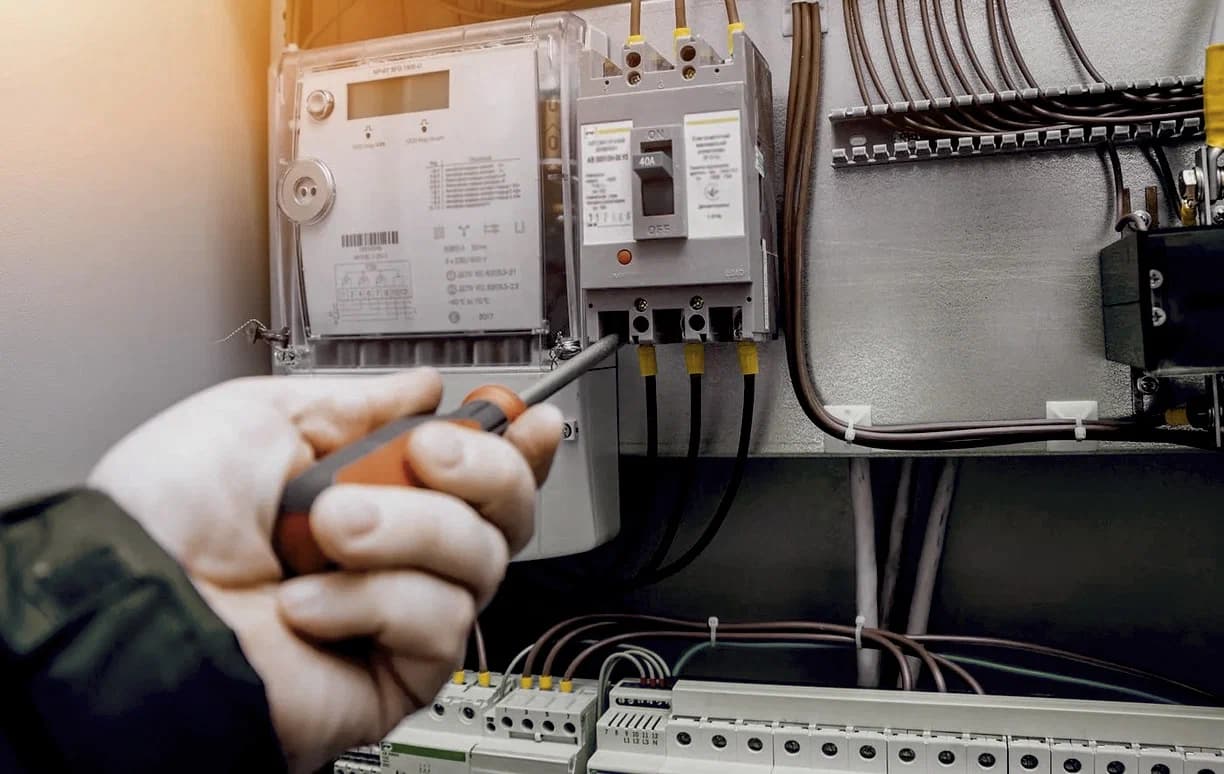
A breaker that trips occasionally is a feature, not a bug — that's exactly what it's designed to do. But a breaker that trips every few days, or trips and won't reset, is telling you something is wrong. Here's how to figure out which of the three common causes you're dealing with, and when it's worth calling a licensed electrician.
Cause #1: Overloaded circuit
This is by far the most common. Most household 15-amp and 20-amp branch circuits are designed to safely carry about 1,440–1,920 watts continuously. If you plug a 1,500-watt space heater into the same circuit as your TV and a hair dryer, you'll trip it.
How to tell: The breaker trips when you turn on a specific high-draw appliance. It resets fine and holds — until you run that combination again.
How to fix: Move the high-draw device to a different circuit (one on a different breaker). If it keeps happening across rooms, your panel may simply be undersized for your household — a panel upgrade or adding dedicated circuits is the long-term fix.
Cause #2: Short circuit
A short happens when a hot wire touches a neutral or ground. The current spikes instantly and the breaker snaps off to prevent a fire. This is more serious than an overload.
How to tell: The breaker trips immediately when you reset it, even with nothing plugged in. You may smell burnt plastic, see scorching around an outlet, or notice a particular outlet sparking.
How to fix: Stop resetting the breaker. Unplug everything on that circuit and try once more. If it still trips with nothing connected, the short is in the wiring or a fixed device (like a wall outlet or hardwired light). Call an electrician — diagnosing a short usually requires opening outlets and tracing the circuit.
Cause #3: Ground fault (with GFCI breakers/outlets)
A ground fault is when current escapes the intended path and tries to go to ground — usually through water or a person. GFCI breakers and outlets in kitchens, bathrooms, garages, and outdoors are designed to detect this and trip in milliseconds.
How to tell: Outlets in a wet area (bathroom, kitchen, exterior) lose power. The GFCI outlet itself or a breaker labeled "GFCI" or "AFCI/GFCI" has tripped.
How to fix: Press the reset button on the GFCI outlet. If it holds, you're done. If it trips immediately, unplug everything on that circuit and try again. If it still won't hold, you may have moisture in an outlet box (common after Antelope Valley winter rain) or a failing GFCI device.
When to stop resetting and call
Resetting a breaker that keeps tripping is unsafe past a few attempts. Call an electrician if:
- The breaker trips immediately, every time, with nothing plugged in
- You smell anything burning or see scorch marks
- The breaker or panel feels warm to the touch
- The same breaker trips weekly, even without unusual loads
- Lights dim noticeably across the house when an appliance starts
What an electrician will check
For a tripping-breaker call, we check the panel for thermal damage, test the breaker itself with a meter, walk the circuit to look for shared neutrals or splices in junction boxes, and use a clamp meter under load to confirm the actual amp draw. Most diagnostics take 30–60 minutes; the fix depends on what we find.
Tripping breakers in Acton, Palmdale, Lancaster, or Santa Clarita? Call B&M Electrical at (661) 676-0615 for same-week service, or request a quote.